Distributed Research Data Ingestion Pipeline for Vector Search
Design and implementation of a distributed pipeline to automate the ingestion, processing, and vector indexing of scientific documents at scale.
Table of Contents
- Introduction
- The Problem
- The Solution
- System Architecture
- Processing Pipeline
- Robustness and Reliability
- Implementation Details
- Conclusion
Introduction
With the exponential growth of scientific publications, efficiently leveraging this data has become a major challenge for modern AI systems. Traditional keyword-based search approaches are no longer sufficient to capture the semantic richness of documents.
In this context, systems based on vector search and Retrieval-Augmented Generation (RAG) require pipelines capable of transforming raw documents into usable representations.
This article presents the design of a distributed research data ingestion pipeline, enabling the automation of the entire workflow—from document collection to vector indexing.
The Problem
Processing scientific documents at scale introduces several challenges:
- Massive volume: thousands of papers published daily (e.g., ArXiv)
- Unstructured data: complex PDFs with text, figures, and implicit structure
- Context extraction difficulty: requires intelligent document segmentation
- Limited search capabilities: traditional methods fail to capture semantic similarity
These limitations make it difficult to build high-performance systems for information retrieval or RAG applications.
The Solution
To address these challenges, we designed a pipeline based on three core principles:
- Distributed orchestration
- Intelligent document processing
- Vector indexing
The global system flow is as follows:
Search → Ingestion → Parsing → Chunking → Embedding → Indexing
This pipeline transforms raw documents into a knowledge base directly usable by AI systems.
System Architecture
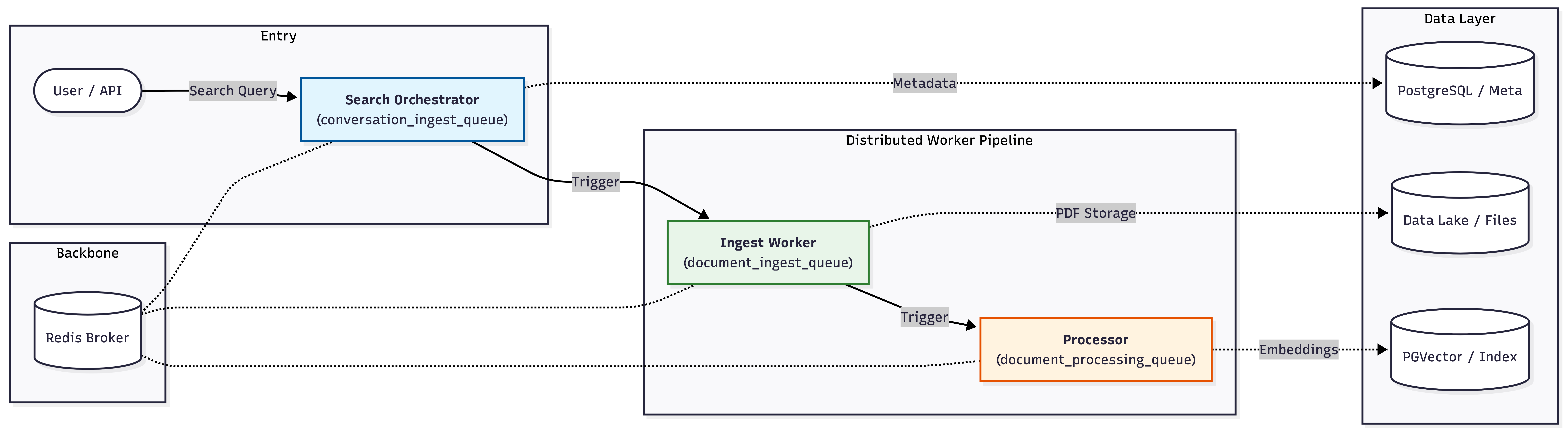
The architecture is modular and distributed:
- Celery + Redis for asynchronous task orchestration
- Specialized workers for each stage (ingestion, download, processing)
- PostgreSQL + pgvector for storage and vector search
- Decoupled queues to isolate pipeline stages
This design enables:
- Horizontal scalability
- High resilience
- Efficient workload management
Processing Pipeline
The pipeline is structured into several stages:
1. Ingestion
- Automated search for scientific documents
- Metadata retrieval
- Registration into the system
2. Download and Parsing
- PDF download
- Text extraction
- Data cleaning and normalization
3. Semantic Chunking
- Splitting documents into coherent segments
- Context preservation
- Optimization for retrieval
4. Embedding Generation
- Use of
sentence-transformers - Conversion of chunks into vector representations
5. Vector Indexing
- Storage in PostgreSQL with pgvector
- Enabling semantic search capabilities
6. Asynchronous Orchestration
Three main pipelines:
- Ingestion queue
- Download queue
- Processing queue
Each pipeline operates independently to maximize throughput and robustness.
Robustness and Reliability
The system is designed for large-scale usage with strong reliability guarantees:
Automatic retries
- Handles transient network failures
- Exponential backoff strategy
Idempotency
- SHA-256 hash verification
- Prevents duplicate processing
Decoupled architecture
- Error isolation
- Improved fault tolerance
Data validation
- Use of Pydantic
- Prevents schema-related failures
Conclusion
This pipeline forms a foundational building block for advanced systems such as:
- RAG systems
- Intelligent research assistants
- Semantic search engines
By combining data engineering, distributed systems, and artificial intelligence, this architecture enables the transformation of large volumes of documents into a scalable, usable knowledge base.
In the long term, such systems pave the way for agents capable of analyzing, synthesizing, and leveraging scientific literature autonomously.
GitHub Repository
You can explore the full implementation and source code on GitHub:
AI Research Data Pipeline
The repository includes the complete pipeline, covering distributed orchestration, document processing, and vector indexing.